Apple’s $1,999 iPhone Duo Might Actually Be Worth the Price
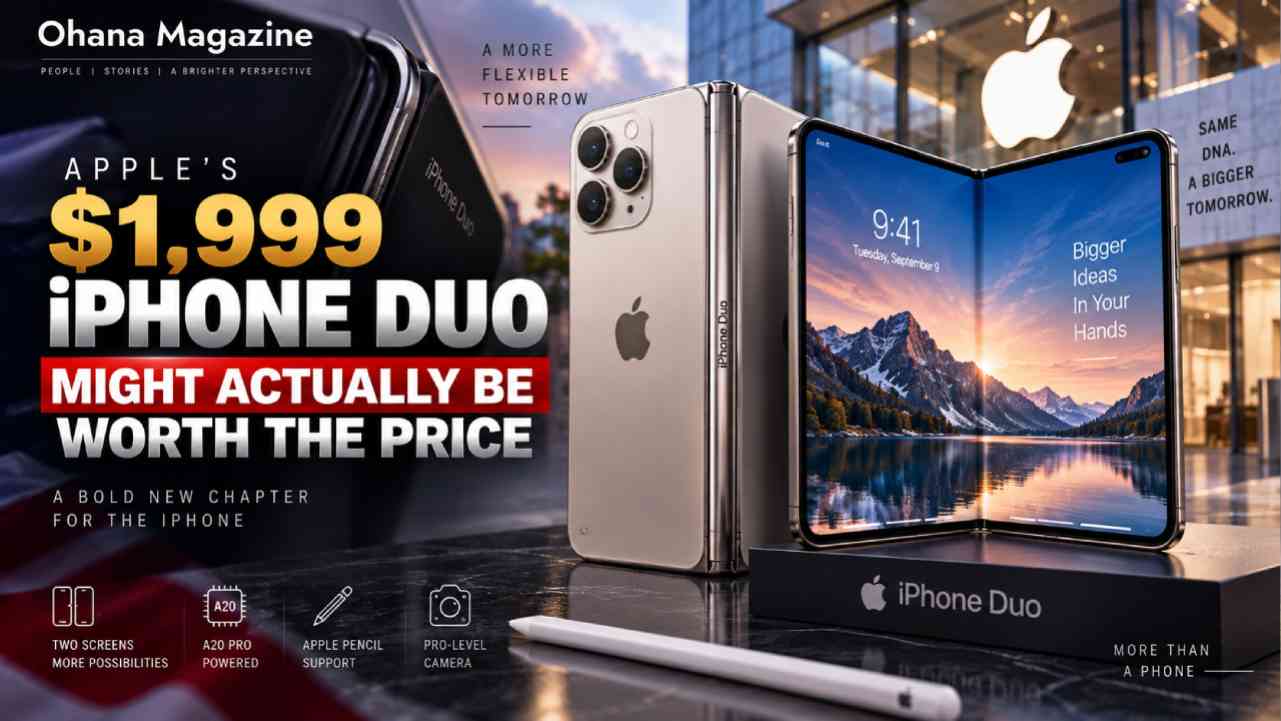
Ohana Magazine – Apple iPhone Duo Foldable has finally moved from years of speculation into reality. Apple officially introduced its first foldable iPhone on September 9, 2026, with a starting price of $1,999. Rather than simply copying an existing folding-phone formula, Apple has built the Duo around a familiar iPhone experience that expands into something closer to a compact tablet. It combines a 5.4-inch outer display with a much larger 7.6-inch inner screen, while the A20 Pro chip handles demanding tasks. Apple also redesigned iOS for the flexible form factor. At nearly $2,000, however, this is clearly not an iPhone for everyone. The more interesting question is whether its ability to replace two devices can make that premium price easier to justify.
Read Also: Modified RTX 5090 Hits 900W Using Three 8-Pin Connectors
Apple iPhone Duo Foldable Marks a Major Shift
Apple waited considerably longer than several rivals before entering the foldable smartphone market. That patience appears deliberate. Instead of presenting the Duo merely as an iPhone that bends, Apple is positioning it as a bridge between a smartphone and a small tablet. Closed, the device behaves much like a compact iPhone. Open it, however, and the 7.6-inch display provides substantially more room for entertainment, gaming, reading, and productivity. Apple says the inner display is 50% larger than the screen on the iPhone 18 Pro Max. Meanwhile, the 5.4-inch outer display provides 90% of the screen area found on the iPhone 18 Pro. Both screens also share the same aspect ratio. Therefore, apps and content can scale more naturally as users move between the two displays. That continuity may prove more important than the folding mechanism itself because software remains one of the biggest challenges for foldable phones.
Two Displays Create a Familiar but Different Experience
The Duo’s two-screen design immediately changes how an iPhone can be used. The smaller outer display is designed for quick tasks and conventional one-handed use. Meanwhile, opening the device creates a considerably larger workspace without requiring users to carry a separate tablet. Apple equipped both displays with ProMotion, Always On technology, and peak outdoor brightness of 3,000 nits. The inner screen also uses a nano-texture finish designed to reduce glare and make the center crease less noticeable. From a practical perspective, those details matter. Foldable phones can look impressive during demonstrations but still feel compromised during ordinary use. Apple appears focused on making the transition between closed and open modes feel less disruptive. Consequently, the Apple iPhone Duo Foldable has a stronger argument than novelty alone. Its real appeal comes from giving users additional screen space only when they actually need it.
iOS 27 Makes the Folding Design More Useful
Hardware alone cannot make a foldable phone successful. Software needs to understand why the extra display space exists. Apple has therefore adapted iOS 27 for side-by-side apps, flexible viewing positions, and other experiences that use the Duo’s folding design. Users can place compatible apps next to each other, creating a workflow closer to an iPad than a conventional iPhone. Apple has also designed the interface so familiar iPhone behavior remains recognizable. That balance could become one of the Duo’s strongest advantages. Existing iPhone owners should not need to relearn basic navigation simply because the device folds. At the same time, the larger canvas can provide meaningful benefits for messaging, browsing, video, documents, and multitasking. In my view, this is where Apple’s late arrival could work in its favor. The company has had years to observe where earlier foldables succeeded and where their software experiences created unnecessary friction.
Apple Pencil Support Pushes the Duo Toward iPad Territory
One surprising addition is Apple Pencil support. Apple says the iPhone Duo will support the USB-C Apple Pencil later in 2026, allowing users to sketch, take notes, and mark up documents on either display. That feature significantly expands the Duo’s identity. A traditional iPhone is primarily designed around touch input, while Apple Pencil has historically belonged to the iPad ecosystem. Bringing the accessory to an iPhone suggests Apple wants the Duo to handle more productivity-focused tasks. For travelers, students, designers, and professionals, that could reduce the need to carry an additional small tablet. However, the value depends heavily on individual habits. Someone who rarely takes handwritten notes may see little benefit. Conversely, users who already rely on an iPad mini-sized device could find the combination compelling. The Duo starts making more financial sense when it genuinely replaces another product rather than becoming an expensive second phone.
A20 Pro Gives the Foldable Serious Performance
Inside, Apple uses the same A20 Pro generation that powers its latest premium hardware. The company has paired the processor with a custom vapor chamber and dual-battery architecture designed to manage heat while maintaining strong performance. The device also includes Apple’s N1 networking chip and C2 cellular modem. These specifications matter because a foldable encourages heavier workloads. Running multiple applications, gaming on the larger display, editing content, and using AI features can generate considerably more heat than checking messages on a standard phone. Apple therefore needs the Duo to perform consistently in both compact and expanded modes. The A20 Pro also gives the phone enough processing headroom for Apple Intelligence and Siri AI features. Raw benchmark performance is only part of the equation, though. Long-term thermal behavior and battery efficiency will ultimately determine whether this hardware feels genuinely premium after extended daily use.
The Camera System Uses the Fold in Clever Ways
Apple equipped the iPhone Duo with a 48-megapixel Dual Fusion camera system. However, the folding body creates possibilities that matter beyond conventional camera specifications. The outer display can help subjects preview their framing while a photo is being taken. Meanwhile, flexible positioning allows the phone to support itself for certain photos, video calls, and hands-free shooting situations. Apple also highlights new camera experiences made possible by the folding design. These features show why foldables become more interesting when manufacturers treat the hinge as a functional tool rather than a visual gimmick. Users can effectively create their own miniature stand without carrying another accessory. Still, camera quality will need to stand up against conventional premium smartphones. At $1,999, buyers are unlikely to accept major photographic compromises simply because the screen folds. The Duo needs to perform like a flagship in every major category.
Read Also: Potentiometer vs Hall Effect vs TMR: Which Analog Stick Is Better?
The $1,999 Price Changes the Conversation
There is no avoiding the biggest barrier: price. Apple says the iPhone Duo starts at $1,999 in the United States with 256GB of storage. Configurations extend through 512GB, 1TB, and 2TB. Preorders begin October 16, while general availability starts October 23 in more than 70 countries and regions. At that price, the Duo sits firmly in luxury technology territory. Yet comparing it only with conventional smartphones misses part of Apple’s proposition. The company is effectively asking whether one folding device can handle jobs normally divided between an iPhone and a compact iPad. For some users, the answer could be yes. For others, buying a less expensive iPhone and keeping an existing tablet will remain more sensible. Therefore, the value equation depends less on whether $1,999 is objectively expensive—it clearly is—and more on how much of the Duo’s expanded functionality a buyer will actually use.
Durability Will Be an Important Real-World Test
Foldable devices naturally raise durability questions because flexible displays and hinges introduce moving components. Apple has responded with a Grade 5 titanium construction, Ceramic Shield materials, and a precision hinge engineered specifically for the Duo. The device also carries an IP68 rating for water and dust resistance. Those specifications are reassuring, but long-term ownership will provide the more meaningful test. Foldable phones are opened and closed repeatedly throughout each day. Therefore, hinge consistency, screen protection, and resistance to everyday wear become especially important. The inner display’s nano-texture treatment also needs to maintain its appearance after months of use. This is particularly significant because the Duo costs considerably more than many traditional flagship smartphones. Buyers spending nearly $2,000 will reasonably expect longevity rather than merely impressive first impressions. Apple’s engineering reputation gives the Duo credibility, but real-world durability will ultimately need to prove it.
Apple iPhone Duo Foldable Could Replace Two Devices
The strongest argument for the Duo is not that it folds. Instead, its appeal comes from potentially reducing the number of devices someone needs. During ordinary moments, it remains compact enough to function as a phone. When more room is required, the larger display can handle movies, games, documents, multitasking, and eventually Apple Pencil input. That versatility changes the value calculation. A buyer who already carries both an iPhone and a compact iPad may see an opportunity to simplify their setup. Meanwhile, someone who uses a phone almost exclusively for messaging, social media, and photography will probably gain less from the expanded display. That distinction matters when discussing whether the $1,999 price is justified. Premium technology becomes valuable when its features solve actual problems. The Apple iPhone Duo Foldable has the potential to do that, but only for users whose routines genuinely benefit from a phone-tablet hybrid.
The Duo Feels Like More Than a Foldable Experiment
Apple’s first foldable arrives with many of the risks expected from a first-generation product. It is expensive, unconventional, and still needs extensive real-world testing. Nevertheless, the Duo also feels more purposeful than a simple attempt to follow an industry trend. Apple has connected its folding hardware with adaptive software, multitasking, a large inner display, Apple Pencil support, the A20 Pro platform, and new camera possibilities. That combination gives the product a clear identity. Reuters described the launch as Apple’s entry into the premium foldable race, where established manufacturers already have years of experience. The $1,999 starting price will keep the Duo outside the mainstream for many buyers. However, those seeking one premium device that can function as both an iPhone and a compact tablet may find the proposition surprisingly reasonable. The real test begins when customers start using it beyond controlled demonstrations.