Ben Shelton Still Has Something to Prove as America’s Tennis Hero
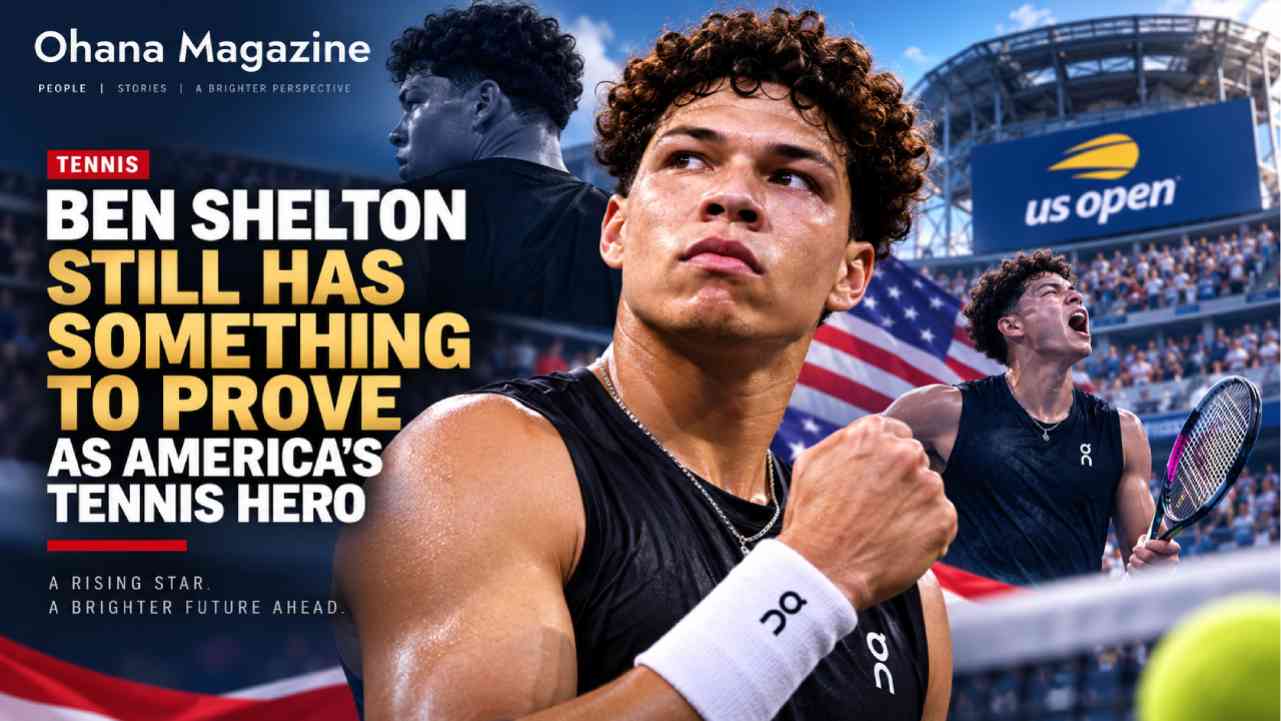
Ohana Magazine – Ben Shelton Tennis Hero became a compelling storyline at the 2026 US Open, where the young American came within one victory of ending a long wait in men’s tennis. His explosive game, infectious energy, and connection with the Arthur Ashe Stadium crowd made his run feel bigger than another successful tournament. However, Alexander Zverev ultimately stopped Shelton in the final. The defeat did not erase what Shelton achieved in New York. Instead, it highlighted both his enormous potential and the areas he must strengthen before carrying the expectations attached to becoming the next great American men’s champion.
Read Also: Joanna Wietrzyk Wins HYROX Beijing Despite Shocking Mid-Race Incident
Ben Shelton Tennis Hero Story Captures New York
New York embraced Shelton throughout his remarkable two weeks at Flushing Meadows. His personality naturally matched the atmosphere inside Arthur Ashe Stadium. He celebrated important points openly, interacted with the crowd, and rarely appeared intimidated by the size of the occasion. More importantly, Shelton gave American tennis supporters something they have waited years to see: a homegrown player competing deep into the second week with a genuine opportunity to win the championship. That connection became particularly visible as the tournament progressed. Every booming serve and aggressive forehand seemed to increase the crowd’s belief. Still, popularity and championship success are different things. Shelton has already demonstrated that he can command one of tennis’s biggest stages. His next challenge is learning how to control matches when excitement alone cannot change their direction.
A Historic Run Changed Shelton’s Career
Shelton’s journey to his first Grand Slam final represented a major step forward. In the semifinal, he recovered from losing the opening set to defeat fellow American Frances Tiafoe 4-6, 6-3, 6-3, 7-5. That victory carried historical significance. Shelton became the first Black American man to reach the US Open singles final since Arthur Ashe in 1972. He was also the first Black American man to reach a major singles final since MaliVai Washington at Wimbledon in 1996. Those milestones provide important context. Shelton was not simply enjoying a popular run in front of a home audience. He was entering territory few American players of his generation have reached. However, reaching the final also created a new benchmark. Future expectations will now involve championships rather than merely deep tournament runs.
Carlos Alcaraz Victory Revealed Another Level
Perhaps the clearest demonstration of Shelton’s potential came before the semifinal. He eliminated Carlos Alcaraz in an extraordinary five-set quarterfinal that finished in the early hours of the morning. The match required far more than Shelton’s trademark serve. He had to manage momentum changes, physical pressure, and an opponent accustomed to competing for major championships. Eventually, Shelton prevailed 6-7, 6-1, 6-3, 1-6, 7-6. That performance mattered because it showed another dimension to his game. Shelton has always possessed obvious athleticism and power. Against Alcaraz, however, he also displayed patience and resilience. For a player still developing his identity at the highest level, victories like this can become important reference points. They prove that beating elite opponents is possible. The next step is reproducing that standard consistently throughout an entire Grand Slam.
Alexander Zverev Exposed the Remaining Gap
The final produced a different challenge. Zverev entered with considerably more experience in the latter stages of Grand Slams and used that maturity effectively. The German defeated Shelton 6-3, 7-6(2), 5-7, 6-2 to claim the championship. Shelton managed to create genuine momentum by winning the third set. Nevertheless, Zverev regained control during the fourth and prevented the American comeback from developing further. That result illustrates why the Ben Shelton Tennis Hero narrative still needs time. At the highest level, spectacular shots are only one part of winning. Players must manage service games, choose the correct moments to attack, and remain disciplined when an opponent refuses to provide easy opportunities. Shelton already possesses weapons capable of troubling almost anyone. Turning those weapons into sustained Grand Slam success remains the larger challenge.
His Powerful Serve Remains a Major Weapon
Few elements of Shelton’s game attract attention as quickly as his serve. The left-hander can generate tremendous speed while creating difficult angles that immediately place opponents under pressure. Yet power becomes more dangerous when combined with variety. Shelton increasingly uses placement, spin, and changes of pace rather than simply attempting to overpower opponents. That development could become crucial as rivals gather more information about his patterns. His forehand also gives him the ability to dictate rallies early. When Shelton finds rhythm, points can disappear quickly for the player across the net. However, elite opponents often force matches into uncomfortable situations. Therefore, Shelton’s long-term ceiling may depend on how effectively he performs when his biggest weapons are neutralized. Developing stronger rally tolerance and smarter point construction could make his explosive tennis significantly more reliable.
American Men’s Tennis Continues Waiting
Shelton’s defeat extended one of the most discussed droughts in American tennis. Andy Roddick remains the most recent American man to win a Grand Slam singles championship, having captured the US Open in 2003. Shelton entered the 2026 final with an opportunity to end that 23-year wait. Zverev’s victory meant the milestone would have to wait for another tournament. Nevertheless, the broader picture remains encouraging for American men’s tennis. Shelton and Tiafoe meeting in the semifinal ensured an American finalist. Their presence also demonstrated that U.S. players can again become central figures during the final weekend of a major. That matters because sporting generations often develop collectively. Competition among American players could push each of them toward higher standards rather than placing the entire burden on one individual.
Becoming a Hero Requires More Than Popularity
There is little doubt that Shelton possesses considerable star appeal. His energetic celebrations, distinctive playing style, and visible enjoyment of competition translate naturally to modern sports culture. However, being entertaining is different from establishing a championship legacy. The Ben Shelton Tennis Hero discussion will ultimately be shaped by what happens during future major tournaments. One memorable US Open can introduce a player to a much larger audience. Repeated success is what transforms that attention into lasting status. That distinction should not diminish his achievement in New York. Instead, it places the tournament in perspective. At 23 during the 2026 US Open, Shelton still has time to refine his game. More importantly, he now understands what competing in a Grand Slam final actually feels like. That experience cannot be replicated during regular tour events.
Physical Endurance Is Part of the Next Challenge
A two-week Grand Slam tests players differently from almost every other tennis tournament. Seven best-of-five-set matches can demand extraordinary physical and mental reserves. Shelton experienced that reality during his run in New York. His quarterfinal against Alcaraz became an exhausting five-set battle, while the semifinal against Tiafoe required another four sets. Two days later, he faced Zverev in the biggest match of his career. This accumulation matters. Champions must not only produce their best tennis. They must preserve enough energy to reproduce it at the end of the tournament. Therefore, Shelton’s development will involve more than technical improvements. Recovery, scheduling, conditioning, and efficient early-round victories could become equally important. His US Open run provided valuable evidence that he can survive demanding matches. Future progress may depend on reaching the final weekend with more physical resources available.
Shelton Now Faces a Different Kind of Pressure
Before this tournament, Shelton could still enter many major events as an exciting challenger. After reaching a US Open final, that perception changes. Opponents will prepare more carefully for him. Crowds will expect deeper runs. Media attention will increase whenever he approaches another major championship. Managing those expectations is part of becoming an elite player. The encouraging sign is that Shelton’s trajectory has continued upward despite occasional setbacks. His combination of athleticism, left-handed serving, aggressive instincts, and confidence gives him a strong foundation. However, development rarely follows a straight line. There will likely be early exits alongside memorable victories. How Shelton responds to those fluctuations may tell us more about his future than any single result.
Read Also: Barcelona Open Champions League Campaign with Five-Goal Statement
Ben Shelton Tennis Hero Status Must Be Earned Over Time
The 2026 US Open did not deliver the ending American supporters wanted, but it changed the conversation surrounding Shelton. He defeated elite opposition, survived an emotionally significant semifinal against Tiafoe, and reached his first Grand Slam championship match. Those achievements provide concrete evidence of progress rather than simply potential. Yet Zverev’s victory also provided an important reality check. Shelton remains a developing player competing against opponents with greater experience in championship situations. That makes his next chapter especially interesting. America does not need to declare its next tennis hero immediately. Shelton has already created reasons to watch him closely. If he turns this breakthrough into repeated Grand Slam contention, the label may eventually arrive naturally. For now, his New York run feels less like the completion of a story and more like the moment the story truly began.