S&P Sees Indonesian Rupiah Strengthening Toward Rp17,700 Against US Dollar
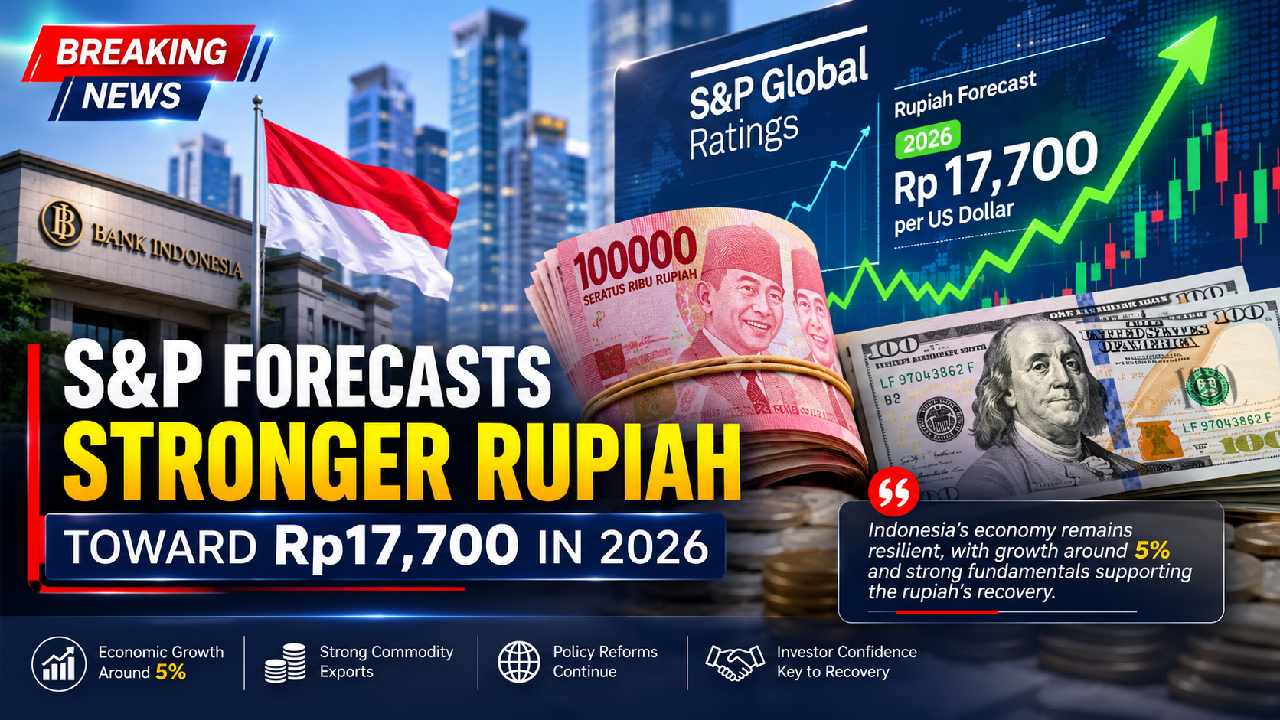
Ohana Magazine – Indonesia’s currency has experienced significant pressure throughout 2026, yet one international credit agency believes brighter days may lie ahead. S&P Global Ratings projects that the rupiah could recover to around Rp17,700 per US dollar before the end of the year, offering renewed optimism for businesses, investors, and policymakers. While financial markets remain volatile, Indonesia’s underlying economic fundamentals continue to demonstrate resilience. Strong domestic consumption, government spending, and resource-based industries have become essential pillars supporting the country’s recovery. Even so, S&P reminds market participants that currency movements are rarely driven by a single factor. Global geopolitical developments, commodity prices, and investor confidence will continue shaping the rupiah’s path over the coming quarters.
S&P Projects the Rupiah to Regain Strength During 2026
S&P Global Ratings believes the Indonesian rupiah has room to appreciate after facing sustained depreciation against the US dollar. According to its latest outlook, the exchange rate could return to approximately Rp17,700 per US dollar during 2026 before strengthening further toward Rp17,500 in 2027. This projection arrives after the rupiah weakened to around Rp18,109 in the spot market, reflecting ongoing financial uncertainty. Nevertheless, S&P emphasizes that Indonesia’s macroeconomic fundamentals remain relatively stable. The agency expects economic growth to stay close to five percent annually, supported by resilient household consumption, infrastructure development, and strategic government investment. For many observers, this forecast represents cautious optimism rather than guaranteed certainty, reminding investors that currency recovery often depends on multiple interconnected domestic and international factors.
Read More : Mount Erebus Releases Tiny Gold Particles
Strong Economic Growth Supports Long-Term Confidence
Indonesia’s economy continued delivering encouraging performance during the first quarter of 2026. Gross domestic product expanded by approximately 5.6 percent year over year, driven by higher consumer spending during extended holidays and faster government budget realization. This growth highlights the resilience of domestic demand despite difficult external conditions. Businesses across retail, transportation, tourism, and services benefited from stronger household activity, creating positive momentum throughout the economy. Furthermore, public infrastructure projects maintained investment flows while supporting employment opportunities. These developments demonstrate that Indonesia’s real economy continues growing even when financial markets experience turbulence. Such economic stability strengthens confidence among international observers and provides an important foundation for S&P’s expectation that the rupiah could gradually regain value over the medium term.
Financial Markets Continue Facing Significant Challenges
Although economic activity remains solid, Indonesia’s financial markets have experienced a noticeably different story. During the first half of 2026, the Jakarta Composite Index lost more than thirty percent of its market capitalization, while the rupiah depreciated roughly seven percent against the US dollar. This divergence illustrates how investor sentiment can differ sharply from economic performance. Financial markets often react quickly to uncertainty, especially when global events create additional risks for emerging economies. Investors remain cautious because capital flows frequently respond to geopolitical developments, interest rate expectations, and commodity price fluctuations. Consequently, currency volatility has remained elevated despite respectable domestic growth. S&P believes this gap between the real economy and financial markets reflects uncertainty rather than structural economic weakness, encouraging policymakers to maintain stability and transparency.
Read More :Venezuela Urges UK to Release 31 Tons of Go
Government Policies Create Both Opportunities and Uncertainty
Indonesia continues implementing ambitious economic reforms designed to strengthen long-term competitiveness. One important initiative involves downstream industrial development, encouraging greater domestic processing of mineral resources before export. S&P believes these policies could increase export earnings while improving government revenue over time. In addition, institutional reforms and the restructuring of state-owned enterprises through organizations such as Danantara are expected to enhance efficiency across strategic sectors. However, policy execution remains equally important as policy design. Rapid regulatory adjustments and implementation uncertainty may temporarily reduce investor confidence if communication lacks consistency. Therefore, maintaining transparent governance and predictable economic policies will be essential to ensuring that reform efforts successfully attract long-term investment while supporting a stronger rupiah and broader financial stability.
Global Risks Continue Influencing the Rupiah’s Direction
International developments remain one of the largest variables affecting Indonesia’s currency outlook. Although concerns surrounding US trade tariffs have gradually eased, fresh geopolitical tensions in the Middle East have introduced new uncertainties. The temporary disruption of shipping routes through the Strait of Hormuz has heightened fears of higher global energy prices. Because Indonesia remains a net importer of crude oil and refined petroleum products, rising energy costs create additional pressure on import expenses and inflation. While Indonesia continues exporting liquefied natural gas, coal, palm oil, nickel, copper, and bauxite, those commodity revenues may not fully offset surging oil prices. As a result, external pressures continue influencing the rupiah alongside broader global investor sentiment and international capital movements.
Trade Balance Pressures Reflect Rising Import Costs
Indonesia’s trade balance has gradually weakened since March 2026 as import expenses increased considerably. Higher global oil prices have significantly raised fuel import costs, while more expensive animal feed materials have affected agricultural production and food supply chains. These developments have expanded pressure across multiple sectors of the economy, increasing operational costs for businesses and influencing domestic prices. Nevertheless, Indonesia continues benefiting from strong exports of several strategic commodities that partially cushion external shocks. Policymakers therefore face the challenge of balancing import dependence with export competitiveness while protecting purchasing power. S&P believes effective fiscal management, sustainable investment policies, and continued structural reforms will remain crucial if Indonesia hopes to strengthen its external position and support a healthier exchange rate environment.
Investor Confidence Will Shape the Next Chapter
Looking ahead, investor confidence will likely determine whether the rupiah achieves S&P’s projected recovery path. Economic growth alone may not guarantee currency appreciation unless accompanied by consistent policymaking, credible fiscal management, and stable financial markets. International investors generally favor countries that combine solid macroeconomic performance with predictable regulatory frameworks. Indonesia possesses many of these strengths, including a large domestic market, abundant natural resources, and favorable long-term demographic trends. Even so, financial markets will continue monitoring geopolitical developments, inflation, energy prices, and government policy execution throughout 2026. If these factors remain supportive, the rupiah could gradually strengthen toward S&P’s forecast while reinforcing Indonesia’s reputation as one of Southeast Asia’s most resilient emerging economies.