Netanyahu Calls for Strong Right-Wing Government After Israel Election Quick Count
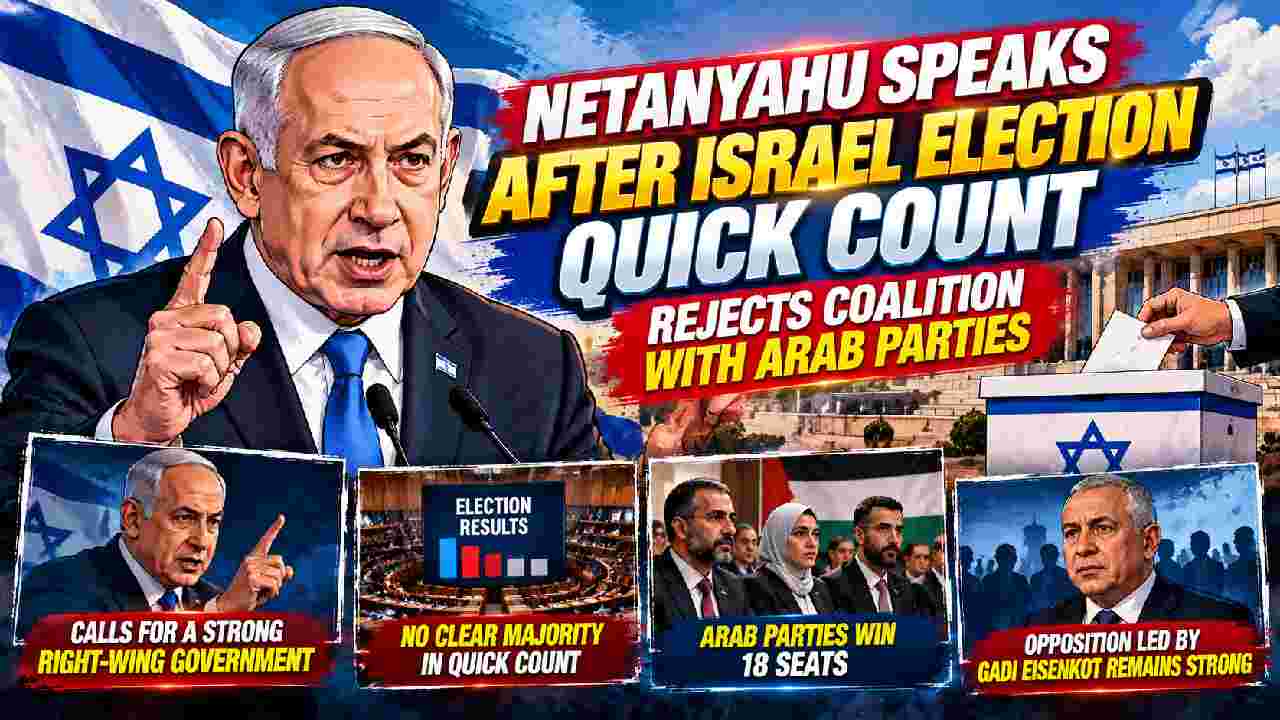
Ohana Magazine – Benjamin Netanyahu addressed supporters early Wednesday after quick-count projections from Israel’s 2026 parliamentary election showed a closely divided political landscape. According to the reported projections, his supporting bloc had not secured enough seats for a parliamentary majority. Still, Netanyahu used his first remarks to push for the creation of a strong right-wing government. He stopped short of directly declaring victory after Tuesday’s vote. Instead, his message focused on what should happen during the next stage of political negotiations. The speech came shortly after 3 a.m. local time, when supporters were still waiting for greater clarity about the final balance of power. Meanwhile, the opposition bloc led by Gadi Eisenkot also appeared short of a majority in the projections. Therefore, neither side seemed able to immediately form a government alone. The uncertain result opened the door to difficult coalition talks.
Likud’s Position Gives Netanyahu Political Leverage
Although Netanyahu did not claim an outright victory, the quick-count projections reportedly placed Likud as the largest individual party in parliament. That position could give him important leverage during negotiations. However, winning the most seats as a single party does not automatically provide enough support to govern. Israel’s parliamentary system requires a coalition capable of commanding a majority in the 120-seat Knesset. Therefore, the wider performance of Netanyahu’s political allies matters as much as Likud’s own result. The reported projections suggested that his bloc had fallen short of that threshold. As a result, Netanyahu’s speech appeared designed to encourage potential allies to remain united. At the same time, the opposition faced its own challenge in assembling enough lawmakers. The election night therefore produced an unusual picture: one party could emerge as the largest force while the wider contest for control of government remained unresolved.
Read More : Alvin Tedjo Wins Mississauga Mayoral Race in Stunning Political Upset
Netanyahu Urges Right-Wing Parties to Stand Together
Netanyahu’s central message was a call for political unity among parties that share his ideological direction. Speaking before cheering supporters, he said Israel should establish a strong right-wing government. He also called for what he described as the Jewish and Zionist majority to unite. Those remarks provided an early indication of the coalition strategy he may pursue after the election. Instead of reaching broadly across the political spectrum, Netanyahu appeared focused on consolidating parties from the right. However, that path depends heavily on the final seat distribution. Quick counts can provide an early picture, but official results and subsequent negotiations determine who can actually assemble a governing majority. Therefore, the political contest did not end when polling stations closed. In many ways, a new phase began. Party leaders now have to calculate which partnerships are possible while balancing ideology, voter expectations, and the numbers required to establish a stable government.
Arab Parties Emerge as an Important Factor
One of the most notable developments in the reported election projections involved Arab parties in Israel. According to the figures cited in the coverage, Arab parties were projected to secure 18 parliamentary seats. Such a result could make their position important if the two larger political camps remain unable to reach a majority on their own. However, Netanyahu made clear that he opposed forming a government dependent on support from Arab parties. He told supporters that such an arrangement would be unacceptable to him. His statement immediately placed the issue near the center of post-election discussions. Meanwhile, other political leaders may have to consider different coalition possibilities depending on the final results. The situation highlights the complexity of Israel’s parliamentary system, where smaller parties can become influential when larger blocs fall short. Therefore, the final political outcome may depend not only on who wins the most seats, but also on which parties can cooperate.
Read More :Iran Warns US Military Bases as Strait of Hormuz Tensions Escalate
Gadi Eisenkot’s Opposition Bloc Keeps the Race Open
The opposition led by Gadi Eisenkot remained a major part of the post-election equation, according to the reported quick-count results. His bloc appeared to be competing closely with Netanyahu’s allies, yet it also lacked enough seats to immediately establish a majority government. That creates a difficult political puzzle for both camps. Eisenkot would need sufficient support from parties outside his core alliance if the final numbers remain fragmented. Meanwhile, Netanyahu faces a similar challenge on the right. As a result, smaller parliamentary groups could gain greater influence during coalition discussions. This stage can involve negotiations over policy priorities, cabinet positions, and agreements between parties with different political interests. However, quick-count projections are not the final result, so the balance could still shift as official counting progresses. Until the numbers become clearer, claims about who will ultimately govern Israel remain uncertain. The election has therefore moved from campaigning into a potentially complicated coalition battle.
Refusal to Rely on Arab Parties Narrows Coalition Options
Netanyahu’s refusal to depend on Arab parties could significantly shape his path toward another government. Coalition building often requires political flexibility, especially when no bloc wins a clear majority. By publicly rejecting one potential source of parliamentary support, Netanyahu has drawn a firm political boundary before negotiations fully unfold. That stance may appeal to his political base and reinforce his effort to unite right-wing parties. However, it could also reduce the number of combinations available if his existing allies remain below the required majority. The final effect will depend on official election results and the willingness of other parties to negotiate. Meanwhile, Netanyahu’s opponents could explore different arrangements of their own. Any such agreement would still require enough lawmakers to support a viable government. Therefore, the days following the election may become just as important as election night itself. Political arithmetic, ideological differences, and negotiations will determine which coalition can ultimately govern.
Israel Now Faces a Crucial Period of Coalition Politics
The quick-count projections leave Israel entering another important period of coalition politics. Netanyahu has made his preference clear: he wants a strong government built around right-wing parties and does not want it dependent on Arab parties. Yet political ambition must still match parliamentary numbers. If neither major bloc reaches a majority, negotiations with smaller parties will become decisive. Furthermore, official results must provide a clearer picture before any governing arrangement can be treated as settled. For voters, that means election day may not deliver an immediate answer about who will lead the next government. Instead, discussions between party leaders could determine the outcome. Netanyahu’s first speech has already established his opening position, while the opposition must decide how broadly it is willing to negotiate. The coming political process will reveal whether ideological allies can unite as Netanyahu requested or whether Israel’s fragmented parliament will require a more complicated governing arrangement.