Jimin BTS Shirt Sells for $110,000 as World Cup Charity Auction Captures Global Attention
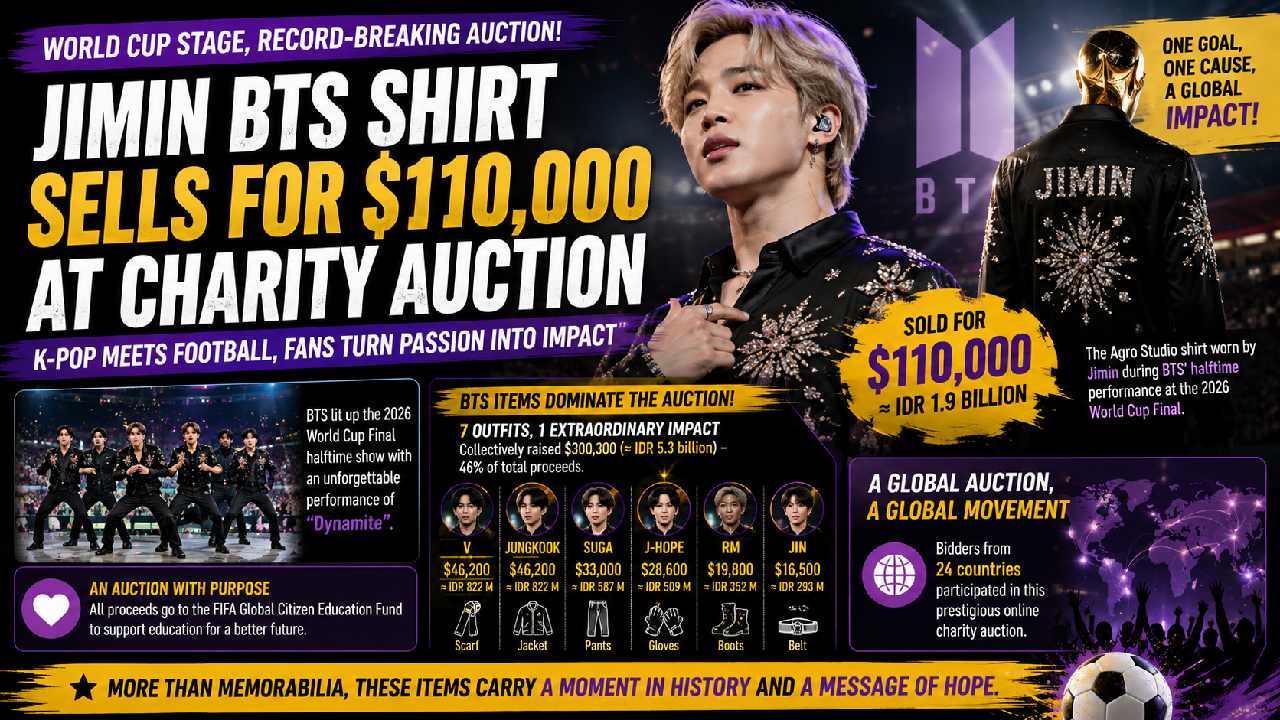
Ohana Magazine – A shirt worn by BTS member Jimin during the 2026 World Cup final halftime performance became the standout item in a high-profile charity auction. According to the information provided, the Agro Studio piece sold for $110,000, or roughly Rp1.9 billion, dramatically exceeding its original estimate. The result was more than a remarkable moment for collectors. It also demonstrated how pop culture, football, and philanthropy can meet on one global stage. The online auction, titled “One Goal: An Auction to Benefit the FIFA Global Citizen Education Fund,” attracted bidders from 24 countries. Overall proceeds reportedly reached $652,630, equivalent to around Rp11 billion. For fans, Jimin’s shirt carried memories of a major performance. For the charity initiative, however, its extraordinary price transformed celebrity memorabilia into meaningful fundraising power and highlighted the increasingly valuable connection between cultural influence and social causes.
Jimin’s Shirt Becomes the Star of the Charity Auction
Among the many collectibles offered, Jimin’s shirt quickly emerged as the auction’s most valuable BTS-related item. Its final price of $110,000 stood far above the initial estimate reportedly placed between $1,000 and $5,000 for individual BTS pieces. That gap illustrates how difficult it can be to measure the emotional value attached to celebrity memorabilia. A shirt worn during an ordinary appearance might already attract dedicated collectors. However, an outfit connected with a World Cup final performance carries an additional layer of cultural history. Moreover, Jimin’s enormous international following created competition far beyond one country or fan community. The successful bid therefore reflected several forces at once: rarity, fandom, sporting history, and charitable purpose. Instead of remaining simply a stage costume, the shirt became a physical reminder of a moment when Korean pop culture appeared before one of sport’s largest global audiences.
Read More : Former Miss North Carolina USA Speaks Out After Losing
BTS Memorabilia Drives Nearly Half of the Auction Revenue
Jimin’s record-setting shirt was not the only BTS item attracting serious bids. Based on the supplied report, seven pieces worn by BTS members during their performance collectively generated $300,300, approximately Rp5.3 billion. That amount represented about 46 percent of the auction’s reported total proceeds. V’s scarf and Jungkook’s jacket each reached $46,200, while Suga’s trousers sold for $33,000. Meanwhile, J-Hope’s gloves attracted $28,600, RM’s boots reached $19,800, and Jin’s belt sold for $16,500. Together, those figures underline the commercial strength of memorabilia connected with globally recognized performers. More importantly, they reveal how fan enthusiasm can translate into substantial charitable funding. Each item carried a different story and belonged to a different member, yet collectively they turned one musical performance into a fundraising engine. For collectors, ownership offered exclusivity; for organizers, that emotional attachment created measurable social value.
A World Cup Stage Adds Another Layer of Cultural Value
The setting behind these clothes played an important role in their appeal. BTS performed during halftime of the 2026 World Cup final, bringing together two enormous global audiences: football supporters and K-pop fans. Consequently, memorabilia from that appearance occupied an unusual cultural space. Buyers were not merely bidding for clothing associated with famous musicians. They were competing for objects connected to an internationally watched sporting occasion. That combination can increase the storytelling value of memorabilia because provenance often matters as much as the physical object itself. A collector can point not only to who wore the piece but also to where and why it became memorable. Jimin’s shirt therefore represents more than fashion or celebrity ownership. It reflects a moment when music crossed into football culture before a worldwide audience. Such crossover events can turn seemingly ordinary garments into artifacts that preserve a specific chapter of contemporary entertainment history.
Read More : Perez Hilton Hospitalized After Police Respond to
International Bidders Turn Fandom Into Charitable Support
The auction reportedly attracted participants from 24 countries, showing that interest extended well beyond South Korea or the United States. This international participation reflects the borderless nature of modern fandom. Digital platforms allow collectors to compete for culturally significant objects regardless of geography, while social media helps memorable performances remain visible long after an event ends. In this case, that global accessibility also benefited a charitable initiative. The auction reportedly raised $652,630 in total for the FIFA Global Citizen Education Fund initiative. Therefore, every competitive bid carried two dimensions. Buyers pursued rare pieces they personally valued, while their spending simultaneously contributed to a broader fundraising objective. This dynamic can make charity auctions especially compelling. Participants receive something tangible with historical or emotional meaning, yet the financial value moves toward a social purpose. Jimin’s shirt became the clearest example of how passionate fandom can produce an impact extending beyond entertainment.
Final Prices Surpass Expectations by an Extraordinary Margin
Perhaps the most striking element of the auction was how dramatically the BTS items exceeded their reported estimates. Christie’s had initially valued individual pieces at approximately $1,000 to $5,000, according to the supplied material. Jimin’s shirt ultimately reached $110,000, demonstrating the unpredictability of high-profile memorabilia auctions. Estimates can consider materials, provenance, comparable sales, and market conditions, but they cannot fully calculate emotional competition between determined bidders. Furthermore, charity auctions sometimes encourage participants to bid more aggressively because the purchase carries a philanthropic dimension. The outcome also shows that cultural relevance can outweigh an object’s conventional material value. Jimin’s shirt was valuable not because of the fabric alone, but because of the person who wore it and the event connected to it. Once those factors combined with scarcity and international demand, its auction value moved far beyond what an ordinary piece of clothing could command.
Pop Culture Memorabilia Is Becoming a Form of Modern History
Celebrity memorabilia often appears playful on the surface, yet pieces connected with defining cultural moments can eventually function like historical artifacts. Clothing, instruments, handwritten notes, and stage accessories preserve stories that photographs alone cannot fully capture. Jimin’s World Cup shirt fits naturally within that tradition. Its significance comes from the intersection of BTS’s global popularity, the scale of the World Cup, and the charitable purpose behind its sale. Moreover, younger collectors increasingly experience history through music, sport, film, gaming, and internet culture. Objects associated with those worlds can therefore carry deep emotional importance. The remarkable bidding illustrates how contemporary audiences decide what deserves preservation. Museums and traditional collectors once dominated that conversation, but global fan communities now play an increasingly visible role. Through auctions like this, an item originally designed for a performance can begin a second life as a collectible representing a particular cultural era.
Jimin’s Auction Record Shows the Reach of Global Fandom
Behind the $110,000 figure lies a broader story about how fandom can create value beyond streams, ticket sales, and merchandise. Fans build emotional connections with performances, songs, and important moments in an artist’s career. When an authentic object from one of those moments becomes available, that connection can create extraordinary demand. Yet the charitable nature of this auction gave the bidding additional significance. Jimin’s shirt became valuable because it carried a recognizable story, while its sale also helped generate funds for an education-focused initiative. The wider BTS collection reinforced the same pattern, contributing nearly half of the reported auction proceeds. Ultimately, the event demonstrated how entertainment communities can become powerful fundraising networks when the right cause meets meaningful memorabilia. A shirt that once belonged to a stage performance consequently became something larger: a collectible, a cultural keepsake, and a striking example of global fan engagement translated into charitable support.