China’s Global Image Rises as Perceptions of the US Shift
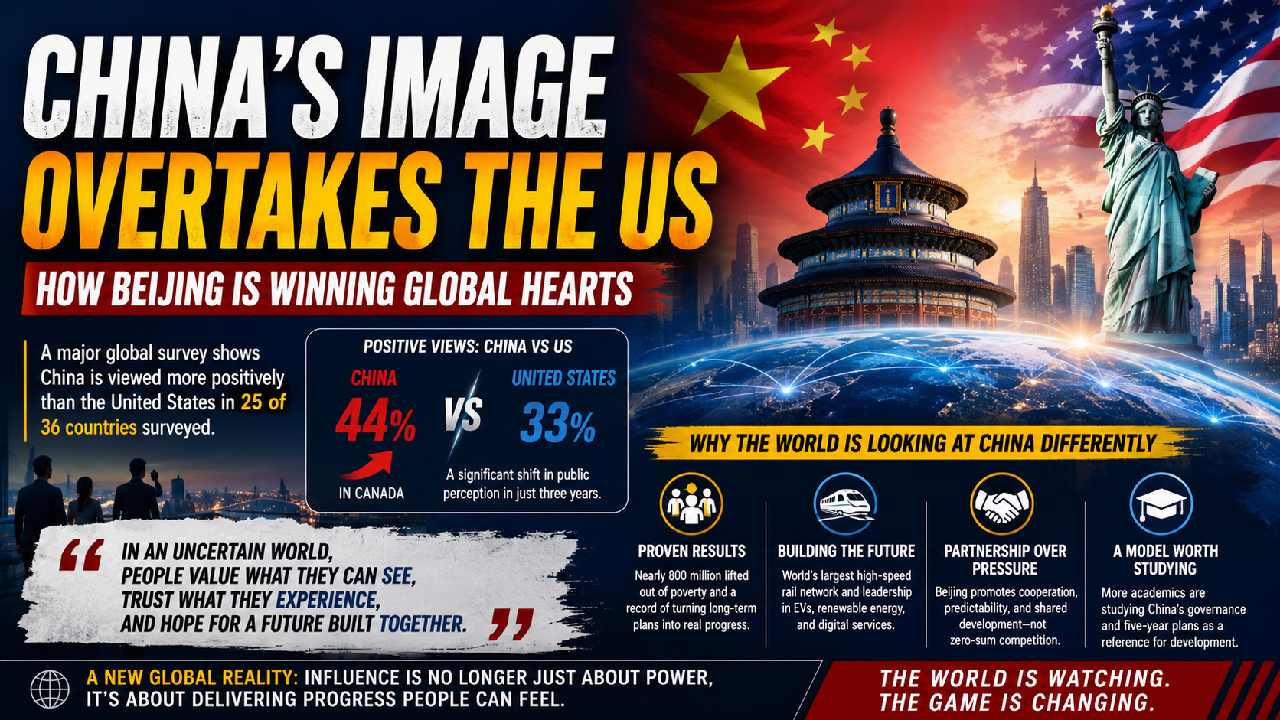
Ohana Magazine – China’s global image appears to be changing at a striking pace. In Canada, a country closely connected to the United States, positive views of China reportedly reached 44 percent this spring. Positive perceptions of the US stood at 33 percent. The reversal is notable because the gap looked very different only three years earlier. Meanwhile, a July Pew Research Center study involving 42,151 adults found China viewed more favorably than the United States in 25 of the 36 surveyed countries, according to the material provided. These figures do not mean every country is embracing Beijing or rejecting Washington. Public opinion is more complicated than a single ranking. Nevertheless, the shift raises an important question about China’s rising global image. Economic performance, infrastructure, technology, diplomacy, and perceptions of international stability can all shape how people judge major powers in an increasingly uncertain world.
Canada Offers a Striking Example of Changing Perceptions
Canada provides one of the clearest examples because of its long political and economic relationship with the United States. A shift in public attitudes there therefore attracts particular attention. The reported figures show positive perceptions of China reaching 44 percent, while the United States stood at 33 percent. Yet these numbers require careful interpretation. Public opinion can respond to domestic politics, international conflicts, trade disputes, leadership changes, and economic concerns. A more favorable opinion of one country also does not automatically mean approval of all its policies. Still, the Canadian numbers illustrate how perceptions of global powers can change faster than traditional alliances might suggest. For Beijing, such changes can strengthen its international image without requiring dramatic diplomatic announcements. For Washington, they highlight the importance of public confidence alongside formal partnerships. Ultimately, influence abroad depends not only on military or economic strength but also on how ordinary people interpret a country’s behavior.
Read More : Russia’s Kuryer Laser Robot Offe
Development at Home Has Become Part of Beijing’s Story
China’s domestic transformation plays an important role in the way Beijing presents itself internationally. Over more than four decades, China has lifted hundreds of millions of people from extreme poverty, while rapidly expanding infrastructure and manufacturing capacity. The country has also built the world’s largest high-speed rail network. More recently, Chinese companies have become major players in electric vehicles, renewable energy, digital services, and advanced manufacturing. These achievements offer Beijing a powerful development narrative. Rather than relying only on political messaging, China can point toward visible projects and economic outcomes. This matters because many developing countries face familiar challenges. Governments want better infrastructure, industrial jobs, affordable technology, and stronger economic growth. However, China’s development record does not erase international criticism or policy disagreements. Instead, it provides another dimension to its global appeal. For observers abroad, practical results can sometimes carry more weight than abstract arguments about competing political systems.
Infrastructure and Technology Strengthen China’s International Appeal
China’s expanding technological and industrial capabilities have also changed how the country is perceived. Electric vehicles, renewable-energy equipment, artificial intelligence, and digital services increasingly place Chinese businesses within global conversations about the future. At the same time, large infrastructure projects have made Chinese engineering capacity highly visible. This combination gives Beijing something valuable in international relations: a reputation for delivering physical and technological development at scale. Countries seeking to improve transportation, energy supply, manufacturing, or digital access may therefore view China through a practical economic lens. However, commercial success and political approval are not the same thing. Governments can cooperate with Chinese companies while maintaining concerns about security, trade practices, or geopolitical influence. Public attitudes can contain similar contradictions. Nevertheless, technological progress has clearly expanded the ways people encounter modern China. For many audiences, the country is increasingly associated not only with manufacturing but also with innovation and ambitious long-term development.
Read More :Iran Vows to Block Any Second
Beijing Promotes Partnership as a Diplomatic Message
According to the Xinhua framing included in the source material, changing perceptions reflect growing interest in partnership, predictability, and shared development rather than pressure or zero-sum competition. That interpretation represents Beijing’s view of the trend rather than an independent conclusion from polling numbers alone. Still, the message helps explain how China seeks to shape its international identity. Chinese diplomacy frequently emphasizes economic cooperation and long-term development. This language can resonate with governments that want investment without being drawn deeply into competition between major powers. At the same time, countries evaluate Chinese partnerships according to their own interests, experiences, and political concerns. Therefore, Beijing cannot control how its message is ultimately received. What it can do is connect diplomacy with visible economic activity. Infrastructure, trade, technology, and investment can reinforce the broader narrative of cooperation. In that sense, China’s image strategy depends as much on practical relationships as it does on traditional public diplomacy.
Long-Term Planning Becomes Part of China’s Soft-Power Appeal
China’s planning system has also attracted attention from researchers interested in how the country turns long-term goals into large development programs. Wang Lei, a professor at Beijing Normal University cited in the source material, said more overseas academics are studying China’s five-year plans and governance logic. From his perspective, stable development and improving living standards have become an important national calling card. That assessment reflects a Chinese academic viewpoint, yet it highlights an important element of Beijing’s international narrative. China often presents policy continuity and long-term planning as strengths in an unpredictable world. For countries struggling with infrastructure gaps or industrial development, the ability to maintain projects across many years can appear attractive. However, governance models cannot simply be transferred from one country to another. Political institutions, economies, and social expectations differ greatly. What travels more easily is the idea that sustained planning can produce visible outcomes when policies remain focused on long-term goals.
Global Influence Is Becoming More Complicated to Measure
The changing perceptions of China and the United States reveal a world in which influence cannot be measured through economic size or military power alone. Reputation now develops across several dimensions at once. People see infrastructure projects, consumer technology, diplomatic disputes, wars, trade policies, and political decisions almost instantly through digital media. Consequently, public attitudes can change quickly. China’s rising global image may benefit from its development record and expanding technological presence, while shifts in views of the United States can also influence comparative polling. Neither trend should be treated as permanent. Countries remain capable of admiring one aspect of a major power while criticizing another. That complexity matters when interpreting international surveys. Still, the reported polling signals something worth watching: global audiences are actively reassessing what they expect from powerful countries. In an increasingly multipolar environment, credibility may depend on whether influence produces outcomes that people regard as stable, useful, and relevant.