The Fed Has a Simple Way to Calm the Bond Market
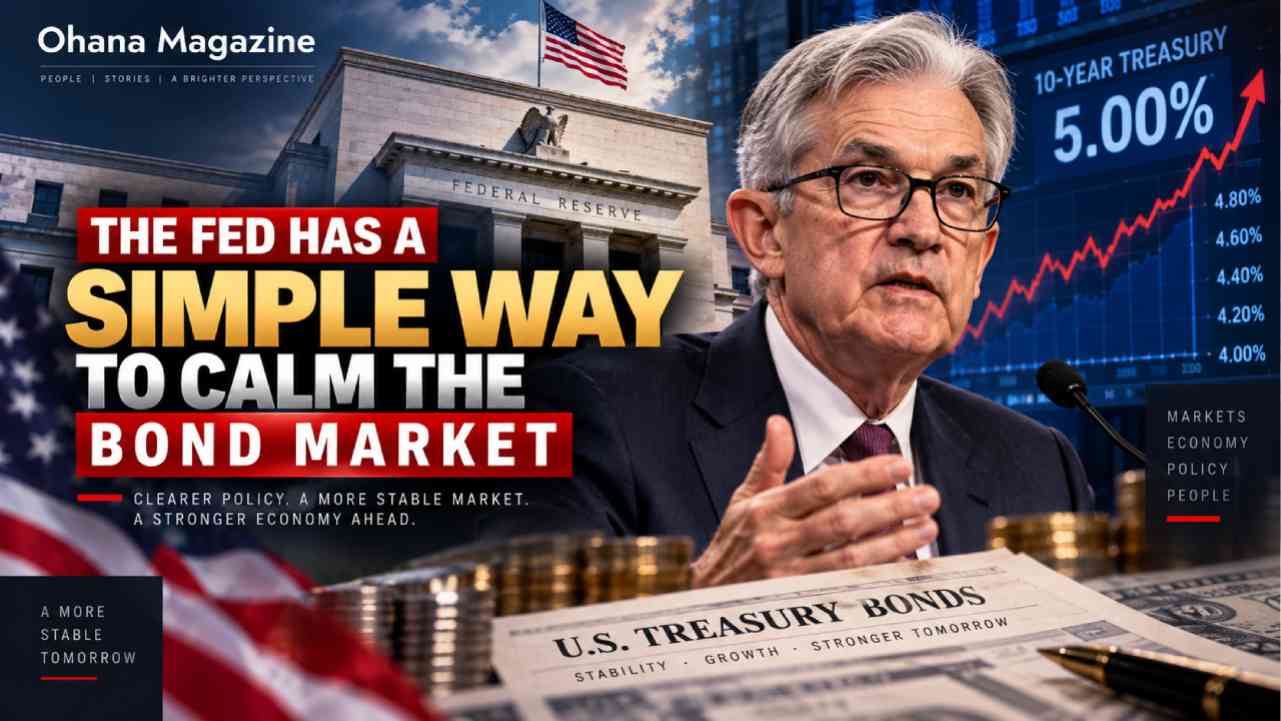
Ohana Magazine – Fed Bond Market Stability has become an increasingly important issue as investors confront persistent inflation, heavy borrowing needs, and rising Treasury yields. The pressure intensified in September 2026 as geopolitical tensions pushed energy prices higher and investors reconsidered how long interest rates may remain restrictive. The benchmark 10-year Treasury yield recently crossed 5% before easing slightly, a level that matters far beyond Wall Street. Higher yields can influence mortgages, corporate financing, consumer credit, and government borrowing costs. Yet the Federal Reserve may not need an extraordinary intervention to restore confidence. Clearer communication about inflation, interest rates, and the conditions that could change policy may offer a simpler path toward calming nervous bond investors.
Read Also: Turkey and Israel Trade Sharp Accusations as Netanyahu Arrest Push Escalates
Fed Bond Market Stability Depends on Confidence
Bond markets often react not only to what policymakers do, but also to what investors believe they might do next. That distinction has become especially important under Federal Reserve Chair Kevin Warsh. Since taking the role, Warsh has avoided giving markets detailed forward guidance. Instead, he has emphasized that future decisions should depend on incoming economic conditions. However, investors still want to understand how the Fed interprets inflation, employment, growth, and financial risks. Without that framework, every new economic report can trigger a larger adjustment in expectations. Therefore, clearer communication could reduce uncertainty without committing the Fed to a predetermined interest-rate path. This approach would preserve flexibility while giving investors a better understanding of the central bank’s priorities. In a market already dealing with fiscal concerns and inflation pressure, predictability itself can become a valuable source of stability.
Treasury Yields Are Sending an Important Signal
The rise in Treasury yields illustrates why investors are paying such close attention. On September 14, the 10-year Treasury yield moved above 5% for the first time since 2023. Federal Reserve data subsequently showed the 10-year constant-maturity yield at 4.97% on September 15, while the 30-year yield stood at 5.34%. Those numbers have practical consequences. When government bond yields climb, financing costs can rise across the wider economy. Mortgages may become more expensive, companies can face higher borrowing costs, and investors may demand better returns before taking additional risk. Moreover, rising yields can increase the government’s interest burden. The Fed cannot directly solve every factor pushing yields upward. Fiscal deficits, Treasury supply, geopolitical risks, and private-sector borrowing also matter. Still, monetary policy expectations remain an important piece of the puzzle.
Kevin Warsh Has Started Giving Markets More Clues
Warsh offered investors an important signal during his first Jackson Hole address as Fed chair in late August. He stressed that inflation remained above the central bank’s objective and indicated that policymakers still had work ahead if price pressures failed to moderate sufficiently. The message reinforced the possibility that tighter monetary policy could remain necessary. For bond investors, the direction of the message mattered. Markets dislike uncertainty, particularly when inflation is already challenging assumptions about future interest rates. However, a single speech cannot establish a complete policy framework. Investors still need to understand which economic developments would meaningfully change the Fed’s judgment. That does not require Warsh to promise specific rate moves. Instead, explaining how policymakers weigh inflation, employment, financial conditions, and growth could make future decisions easier for markets to interpret.
A Reaction Function Could Reduce Market Uncertainty
One concept receiving renewed attention is the Fed’s “reaction function.” In simple terms, this describes how policymakers assess economic conditions and determine whether monetary policy should change. It differs from forward guidance because it does not require officials to predict their next move. Brookings notes that Warsh has resisted traditional forward guidance and declined to preview future decisions. A clearer reaction function could therefore provide a useful middle ground. For example, the Fed could explain which inflation trends would strengthen the case for tighter policy. It could also describe how weakening employment or slower demand might alter that assessment. Investors would still need to interpret economic data, but they would have a clearer framework. Consequently, markets might spend less time guessing what each new number means for policy. For Fed Bond Market Stability, that additional clarity could prove more useful than dramatic intervention.
Inflation Credibility Matters More Than Short-Term Comfort
The Fed’s challenge is not simply lowering bond yields. In fact, trying to suppress yields while inflation remains elevated could create a larger credibility problem. The central bank’s longer-term objective is price stability, and Warsh has repeatedly emphasized the importance of bringing inflation toward the Fed’s 2% target. Meanwhile, markets entered the September policy meeting expecting tighter monetary policy. A Reuters poll published September 14 found that 85% of surveyed economists expected a quarter-point rate increase. That environment makes communication especially important. Investors need confidence that policymakers will respond when inflation becomes persistent. At the same time, they need enough information to understand why policy changes. If the Fed communicates that framework consistently, long-term inflation expectations may become easier to anchor. That could eventually reduce some of the risk premium embedded in longer-term yields.
Quantitative Easing Is Available but Unlikely
The Federal Reserve has another powerful option: its balance sheet. During previous crises, the central bank purchased large quantities of Treasury securities and mortgage-backed securities through quantitative easing. Such purchases can support market liquidity and influence longer-term borrowing costs. However, current conditions are very different from a severe financial crisis. Reuters reported on September 16 that analysts viewed direct Fed intervention in the bond market as unlikely unless trading conditions became genuinely distressed. The central bank also remains focused on inflation and preserving institutional credibility. Using quantitative easing simply because yields are uncomfortable could send a confusing message. On one side, the Fed would be trying to restrain inflation. On the other, large bond purchases could appear designed to loosen financial conditions. Therefore, clearer policy communication remains a less disruptive option while markets continue functioning normally.
Read Also: Philippine Court Issues Arrest Warrant for VP Sara Duterte
History Shows Why Yield Control Carries Risks
The United States has previously used much stronger methods to influence government borrowing costs. During World War II, the Federal Reserve helped maintain low Treasury yields as the government financed enormous wartime spending. However, that arrangement eventually created tension between monetary independence and government financing needs. The 1951 Treasury-Fed Accord marked an important shift by restoring greater independence to monetary policy. That history remains relevant today because central-bank credibility depends partly on investors believing that inflation decisions are not dictated by government financing requirements. Current concerns about high federal borrowing costs naturally create pressure for lower yields. Nevertheless, forcing yields down could blur the line between monetary policy and debt management. For that reason, Fed Bond Market Stability may depend more on credibility than direct market control. A trusted central bank can influence expectations without buying every bond investors are unwilling to hold.
Fiscal Pressure Is Beyond the Fed’s Direct Control
Not every problem in the bond market originates with monetary policy. Investors are also evaluating large government borrowing requirements, corporate debt issuance, inflation risks, and changing global demand for U.S. securities. Reuters reported that heavy debt issuance and concerns about the American fiscal outlook contributed to the recent rise in Treasury yields. These forces limit what the Fed can realistically accomplish. Even perfect communication cannot eliminate concerns about government deficits or suddenly reduce Treasury supply. However, the central bank can prevent monetary uncertainty from becoming another source of volatility. That distinction matters. The Fed does not need to promise lower yields. Instead, it can make its own decision-making process easier to understand. Investors can then price fiscal, inflation, and geopolitical risks without simultaneously guessing how policymakers might react.
Clear Communication Could Be the Simplest Tool
The bond market does not necessarily need reassurance that interest rates will fall. What investors need most is confidence that the Fed has a coherent framework for responding to changing economic conditions. That makes communication surprisingly powerful. If Warsh explains how inflation, employment, growth, and financial conditions influence policy, investors can form expectations with less speculation. Moreover, transparency does not require the Fed to sacrifice independence or promise a particular rate path. The central bank can remain flexible while making its priorities clearer. That approach may be especially valuable when Treasury yields are already near levels that affect borrowing costs throughout the economy. Ultimately, Fed Bond Market Stability cannot be created through words alone. Yet credible and consistent communication can remove one unnecessary layer of uncertainty from a market already dealing with plenty of it.